



Executive Director Ann Cundy Featured on Shenandoah Valley Life Podcast
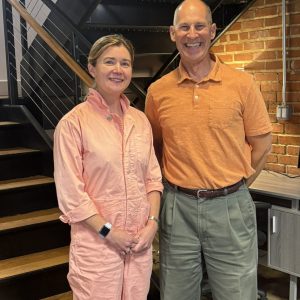
Executive Director Ann Cundy recently joined host Jay Langston on the Shenandoah Valley Life Podcast, sharing about her years in the region and CSPDC’s role in supporting local communities. The Shenandoah Valley Partnership podcast showcases residents who are living, working and thriving in Virginia’s iconic valley.
During their conversation, Ann discussed her lifelong connections to the Valley and explored how CSPDC’s diverse programs work hand-in-hand with SVP’s efforts to boost economic development and create jobs throughout the region. Since launching in 2021, SVP has produced 55 podcast episodes featuring local leaders and innovators.
Curious to learn more about CSPDC’s regional initiatives? Listen to Ann’s episode of the SV Life podcast here.
I-81 Transformation Continues: Updates to Corridor Study
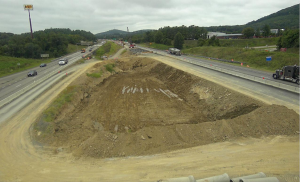
Widening activity in Staunton
Virginia continues efforts to transform the Interstate 81 corridor with a comprehensive new study. The Virginia Department of Transportation (VDOT), working alongside the Office of Intermodal Planning and Investment and the Department of Rail and Public Transportation, is developing an updated Corridor Improvement Plan (CIP) for the entire 325-mile I-81 corridor within the Commonwealth. This latest initiative builds upon the success of the previous 2018 study, which identified 65 construction projects worth approximately $3 billion that are already completed or are now in development.
Current and Upcoming Projects in Our Region
The Staunton Construction District has two active projects and three more on the horizon:
Currently Underway:
- Widening to three lanes between Exit 221 and Exit 225 in both directions through the City of Staunton (completion projected for June 2027)
- Adding a truck climbing lane near Weyers Cave between mile markers 234 and 237 Southbound (completion projected for December 2027)
Planned Projects:
- Widening to three lanes between Exit 243 and 247 in both directions through Harrisonburg (anticipated start September 2025)
- Extending the acceleration/deceleration lane on the Southbound side of the Mt. Sidney rest area in Augusta County (anticipated start January 2028)
- Widening to three lanes in Rockbridge County between Exit 205 and 200 Southbound (anticipated start May 2028)
With these planned improvements in progress, VDOT is reassessing traffic conditions to determine which areas require attention next, focusing on segments with the highest rate and severity of crashes or the most significant traffic delays while excluding portions where recent widenings or truck-climbing lanes have been completed or are currently under development.
Through a three-phase public engagement process, VDOT will gather community input throughout the planning process. The initial spring phase focused on issue identification through virtual surveys and interactive mapping, allowing the public to report safety and congestion problems. During the summer phase, completed in July 2025, the study team presented potential solutions at four in-person meetings held in Weyers Cave, Winchester, Bristol, and Salem, with nearly 1,700 people responding to the accompanying online survey. You can view the presentation and project boards that were shared at these public meetings at the following links:
Proposed Projects in the Staunton District
I-81 CIP Round 2 – Potential Solutions Presentation
The final engagement phase this fall will help refine recommendations before presenting them to the I-81 Advisory Committee and Commonwealth Transportation Board by year’s end.
Community input remains crucial to the success of these transportation improvements, which focus on enhancing safety, reducing congestion, and supporting economic growth along this vital corridor that serves as a critical artery for freight movement and regional connectivity.
Learn more about the 2025 Corridor Improvement Plan Study, projects previously completed and those underway at www.Improve81.org.
Danielle Gannon Selected for Virginia Transit Leadership Institute
We are proud to announce that Danielle Gannon has been selected to join the Virginia Transit Association’s (VTA) third cohort of the Virginia Transit Leadership Institute (VTLI).
The Virginia Transit Leadership Institute is a nine-month intensive program designed for mid-level professionals and future executives ready to see transit through a comprehensive, statewide lens. Through five immersive full-day sessions, participants will dive deep into leadership development, expand their industry knowledge, and enhance critical skills that will shape Virginia’s transportation landscape.
Danielle will join peers from across Virginia’s transit ecosystem, including representatives from Hampton Roads Transit, Washington Metropolitan Area Transit Authority, Greater Richmond Transit Company, DASH/Alexandria Transit Company, and many others. This diverse cohort brings together perspectives from urban and rural systems, creating a rich learning environment that reflects Virginia’s varied transportation needs.
Danielle’s selection reflects both her individual expertise and the CSPDC’s commitment to advancing public transportation in our region. The knowledge, professional connections, and leadership skills she’ll gain through VTLI will directly benefit the communities we serve, ensuring our transit planning efforts remain innovative and responsive to evolving needs.
The program will culminate in a graduation ceremony at the VTA Annual Conference Awards Luncheon in 2026. Congratulations, Danielle, on this well-deserved recognition!
The Virginia Transit Association represents over 125 members working together to advocate for more efficient and sustainable public transportation throughout Virginia.
Grottoes Adopts New Comprehensive Plan, Launches Multimodal Transportation Study
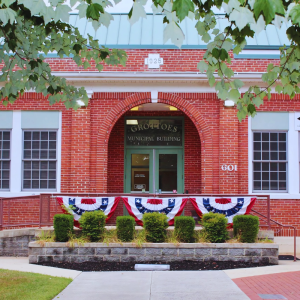
After 18 months of collaborative planning, the Town of Grottoes has officially adopted its Comprehensive Plan 2025-2045, setting the stage for strategic growth and community improvements over the next two decades.
CSPDC staff led the comprehensive planning process with Grottoes, facilitating extensive community engagement through surveys and public input sessions. The CSPDC team conducted demographic analysis and developed strategic goals and objectives that will guide the town’s future land use decisions.
The resulting Comprehensive Plan provides an overview of the Town’s present needs along with a holistic vision for Grottoes through 2045, addressing the full spectrum of physical, social, and economic development needs while reflecting community-driven priorities. Following this collaborative planning effort, the Town Council unanimously adopted the final plan on July 14, 2025.
Next Step: Improving Walkability and Biking
One of the first projects that will come out of this newly adopted plan originates from a high priority need shared by Grottoes residents who expressed a desire to further develop walking and biking facilities to improve the overall quality of life across the Town. Building on the foundation of the Comprehensive Plan, the CSPDC will now work with the Town to develop a Multimodal Master Plan for Grottoes that will:
- Assess connectivity across existing sidewalk, cycling, and trail networks
- Identify priority connections to key destinations including Grand Caverns, local businesses, schools, and neighborhoods
- Provide a prioritized list of bicycle and pedestrian improvements with cost estimates
- Include funding recommendations to help the town compete successfully for state transportation grants
This strategic approach positions Grottoes to systematically expand its walking and biking infrastructure while building on the strong foundation established with the assistance of CSPDC’s comprehensive planning work.
Regional Hazard Mitigation Plan Achieves Milestone
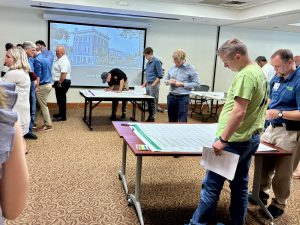
On August 8th, the CSPDC’s Community and Economic Development team achieved a major milestone by hosting the final steering committee meeting for the new Regional Hazard Mitigation Plan. Nearly 40 representatives from local governments, regional organizations, and state agencies gathered at Augusta Community Care to collaborate on this critical planning initiative.
The steering committee finalized a set of regional goals and strategies that will guide the region’s hazard mitigation efforts over the next five years. The goals focus on six community themes:
- Economic Resilience
- Housing and Neighborhood Protection
- Environmental Stewardship
- Public Infrastructure Hardening
- Public Health and Safety Enhancement
- Regional Collaboration and Innovation
The Plan’s Threat and Hazard Identification and Risk Assessment (THIRA), which evaluates the region’s vulnerability to specific natural hazards and man-made threats, informed the steering committee’s discussion. Among the 12 hazards and threats analyzed, flooding, wildfires, severe winter weather, and hazardous materials release had “high” risk ratings. Additionally, the region faces unique challenges to bolstering its infrastructure, given its karst landscape and communication restrictions under the National Radio Quiet Zone (NRQZ).
This fall, the CSPDC will incorporate the committee’s input and work with localities to identify specific projects that will boost community resilience. Once approved by the Virginia Department of Emergency Management (VDEM) and the Federal Emergency Management Agency (FEMA), these projects will become eligible for federal grant funding.
Watch CSPDC Connects for a draft plan and opportunities to provide comment and input later this fall.