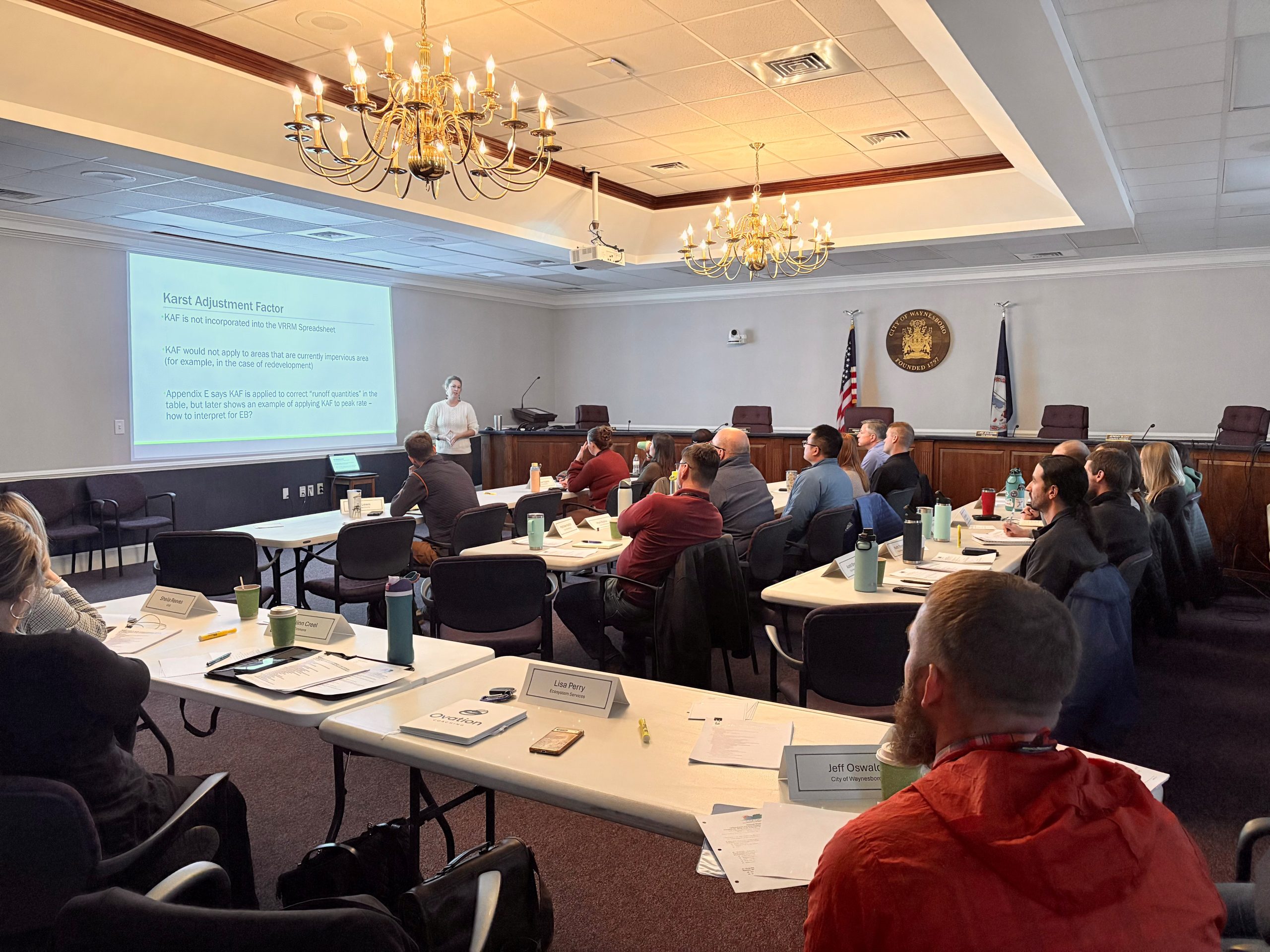
The CSPDC hosted an Urban Karst and Stormwater Workshop on October 28th in Waynesboro City Council Chambers, bringing together approximately 35 stormwater management and public works professionals from across the region. The full-day event explored challenges and best practices for planning and implementing stormwater projects on karst, a geological feature that can complicate conventional approaches.
A primary focus was Appendix E of the Virginia Stormwater Management Handbook, released by the Virginia Department of Environmental Quality (DEQ) earlier this year. Appendix E provides site assessment and design guidelines for stormwater management in karst terrain, helping practitioners navigate the technical complexities these geological conditions present.
The workshop featured four expert speakers with extensive karst and stormwater experience. Wil Orndorff, Karst Protection Coordinator for the Virginia Natural Heritage Program at the Department of Conservation and Recreation, co-authored the draft of Appendix E and provided insights into karst geology throughout the Shenandoah Valley. Lisa Perry, a Mitigation Specialist at Ecosystem Services with prior experience administering erosion control and stormwater management for Rockingham County, shared perspectives on regulatory compliance in karst areas. Sheila Reeves, Water Resources Service Director at VHB, drew on her expertise in stormwater management, watershed planning, and floodplain compliance to discuss project planning strategies for karst sites. Aislinn Creel, Senior Stormwater Project Manager at Timmons Group, joined Reeves to present a case study on Mulberry Run Wetlands, an award-winning constructed wetland in Waynesboro that successfully addressed stormwater management challenges in a karst environment.
The workshop concluded with a site visit to Mulberry Run Wetlands, allowing participants to see firsthand how innovative design can overcome karst-related obstacles while achieving effective stormwater management and ecological benefits.